
SEO is arguably the most effective marketing channel for B2B SaaS companies when executed the right way.
No other channel organically builds more trust, compounds results, and drives long-term ROI quite like organic search.
Plus, SEO fits the SaaS industry like a glove. Over 70% of B2B buyers begin their buying journey with a search engine like Google.
This allows you to meet your customers on the platform they use most—and if you rank for high-intent keywords, it helps them discover your product when they’re actively in-market.
Meaning you’re not interrupting their journey like outbound marketing does. They’re coming to you.
These are a few reasons why organic search is the king of SaaS marketing… but they certainly aren’t the only reasons.
In this blog, we’ll break down the exact SEO strategies you can use to drive organic growth for your SaaS company.
What Is SaaS SEO
“SaaS SEO” is a digital marketing strategy, specifically for B2B SaaS websites, that helps improve their organic visibility in search engines like Google.
It’s the reason Salesforce appears first when you Google “best CRM software”, ahead of countless other CRM sites. Ranking well gives companies massive amounts of brand visibility and leads.
Not all SEO is created equal, though. SEO for software industries is a bit different than SEO for other industries.
SaaS products typically solve very specific problems for specific audiences. They tend to have longer sales cycles and higher average order values.
Every SaaS product is unique and needs its own tailored strategy. Great SEO agencies understand this and act accordingly. Loopex Digital’s SaaS SEO services follow this exact principle.
Is SEO a Bad Investment for SaaS?
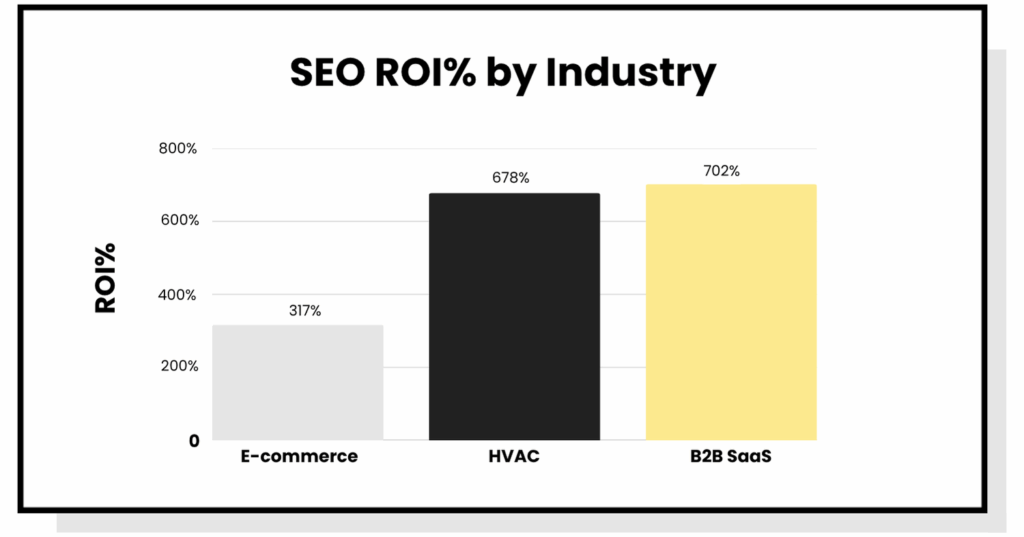
In most cases, it’s a great investment. But it’s certainly not for everyone. B2B SaaS companies investing in SEO see an ROI of 702% and a breakeven average of about 7 months.
But in some markets, organic search simply doesn’t make sense. Here’s when it’s a bad idea:
- You’re Relying on Urgency-Driven Needs: Some tools solve time-sensitive problems (like “cancel subscriptions fast”), these users act quickly and don’t typically read content.
- Low Search Volume / Demand: If no one is Googling things related to your product, SEO probably won’t drive any traffic. People in your niche need to be searching for something.
- New or Untapped Market: If you’re building something innovative, the market is brand new, and people aren’t searching for it yet… They’ll likely need to be educated first.
- Short Customer Lifespan or Low LTV: If your average customer pays $7/month and churns in 3 months, the ROI from SEO will probably never justify the cost.
- Hyper-Niche or Offline Audiences: SaaS products targeting legacy industries (like factory equipment management or field inspection tools) may not have an audience that’s digitally savvy.
My SaaS Keyword Research Strategy
Keyword research and content planning is where so many SaaS SEO campaigns go wrong.
They chase top-funnel keywords with high search volume, instead of targeting queries that actually lead to business results. Traffic matters, but it shouldn’t be a top priority.
Targeting high-volume keywords can lead to high traffic, but often little revenue. Here are some results-driven keyword research tips.
Define Your Goals and KPIs
Your strategy will go nowhere without specific goals in mind. Just like you do for your company, you need to choose some KPIs that matter for your growth.
MQLs generated from organic search, trial signups from content, etc. Traffic should NOT be at the top of the list, despite what many people think.
Deeply Understand Your Ideal Customer
Before jumping into any keyword research tools, you should know your audience like the back of your hand. Be aware of things like common slang they use, pain points, questions, opinions, etc. You can find these in:
- Interviews with your customer success team
- Customer feedback surveys and reviews
- Popular industry newsletters
- Social media content
- Sales call recordings
Ideally, you should take notes obsessively about every small detail of your ICP.
Create a Keyword List
Create a spreadsheet and start building your keyword list using what you learned about your audience. Try to think like your customers and write the exact phrases they’d type into Google.
Don’t focus on keyword data yet. Your main focus should be getting every single idea written down. Once you’ve used up all the keyword ideas from your audience research, look over your list and group them by intent.
Maybe you found mostly educational topics, but you already get plenty of website visitors and need content that actually converts them into customers. You can then change your focus to find the more relevant topics.
This is also a great time to try other keyword research methods, like using common keyword frameworks that we’ll get into shortly.
Start with Bottom-Funnel Content
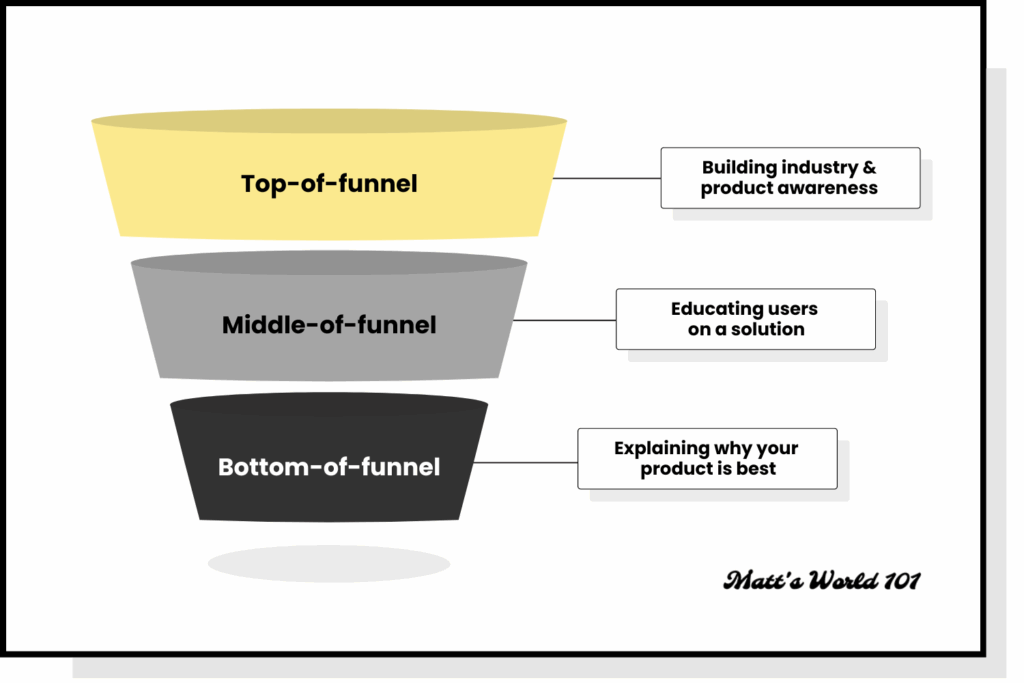
These are terms buyers search for when they’re near the end of their buyer journey and ready to purchase. BoFu topics often have lower search volume than ToFu, but convert leads at a 25x higher rate.
The vast majority of all BoFu content is based on a comparison of some sort. Comparison pages convert so well because the searcher is actively comparing options, typically just before purchasing.
Examples of BoFu keyword frameworks:
- “[Your tool] vs [Competitor]”
- “[Your tool] vs [Competitor] vs [Competitor]”
- “[Your category] alternatives”
- “Best [tool] for [use case]”
- “[SaaS tool] cost”
- “[top competitor] pricing“
Sometimes, even if a BoFu keyword has very little search volume, it might still be worth creating content around. This is especially true if you have a high average order value, and a single conversion generates lots of revenue.
One website that creates tons of comparison content is the Zendo blog. They’re a client portal software company, and they have excellent BoFu content examples you can take note of.
When creating comparison content, many companies have a tendency to be biased towards their own product. This will often backfire, as readers can sniff out bias pretty easily. So be honest!
Another thing about BoFu content is that it’s less negatively impacted by AI Overviews than ToFu. Google’s AI summaries seem to target informational queries much more.
Bottom-funnel topics are some of the most important on your website. They drive the most leads, and can sometimes even convert better than landing pages!
Build Middle-Funnel Content
Once you’ve covered BoFu keywords, it’s time to find MoFu keywords. MoFu keywords target prospects who know they have a problem but aren’t quite ready to purchase.
These users are in the consideration stage and need more education before they’re ready to compare tools. The idea is to educate them on how they can solve their problem using your SaaS tool.
However, being overly-promotional of your product can have huge negative effects here. This is why you should always solve their problem first, before promoting anything.
Then, you can introduce your product in a natural, “non-salesy” way.
Here are some MoFu keyword frameworks:
- “How to [solve specific problem]”
- “Why [problem] happens”
- “[Problem] solutions”
- “Best practices for [specific challenge]”
- “[Industry] [problem] guide”
For example, if you sell project management software, instead of targeting “project management tools” (BoFu), you’d target “how to manage remote team deadlines” or “project timeline best practices.”
One other effective strategy is to create Jobs-to-Be-Done (JTBD) content. This focuses on the specific tasks your prospects need to accomplish. Asana executes this perfectly with content like “how to create a project timeline.”
The structure works like this:
- Address the immediate problem: Provide genuine value by thoroughly solving every part of the reader’s issue
- Demonstrate your solution: Naturally show how your tool makes the process easier
- Include soft CTAs: Offer free trials or demos without being too pushy
This content builds trust by helping users accomplish their goals while naturally introducing your product as the better way to handle the task.
The beauty of pain point SEO is that it attracts people when they’re actively problem-solving. Instead of interrupting their workflow, you’re becoming part of their learning process. This naturally builds trust with your readers.
Create Top-Funnel Content
Top-of-funnel content is primarily for educating new readers who are just discovering your industry. ToFu content doesn’t convert very often. Recently, it’s become less valuable due to Google’s AI Overviews summarizing informational topics without a click.
However, there is a huge secondary benefit here: Topical relevance. Topical relevance, or “topical authority” in SEO slang, is when Google favors sites that cover one topic deeply with many related pages.
Google is a semantic search engine. So when you have lots of semantically related content around one core topic, Google trusts you more. This results in an increase in rankings.
MoFu and Bofu content build topical relevance too. But there are typically less opportunities to write content on in these funnel stages.
Examples of common ToFu keyword frameworks:
- “What is [industry term]”
- “[Industry] guide for beginners”
- “How [industry process] works”
- “[Industry] best practices”
- “[Industry] trends [current year]”
- “Benefits of [industry solution]”
- “[Industry] vs [related industry]”
- “Types of [industry tools/methods]”
- “[Industry] statistics”
- “Common [industry] mistakes”
You want to focus on creating valuable, comprehensive content that genuinely helps your audience. Avoid regurgitating content that can be easily found on other sites. Put your unique spin on it.
For example, if you’re a CRM company, you might create content around:
- “What is CRM software” (definitional)
- “Sales pipeline management best practices” (educational)
- “CRM trends 2024” (trending)
- “CRM ROI statistics” (data-driven)
ToFu content might not be as valuable as BoFu content. But it’s still very valuable in 2025, and it’s a necessity if you want to reach your full SEO potential.
Using AI for Keyword Brainstorming
Generative AI tools like ChatGPT and Gemini aren’t perfect, but they’re great for coming up with new keyword ideas.
You’ll still need to sort through some weak ideas and check the good ones with proper keyword research tools.
I’ve tested hundreds if not thousands of AI prompts. If I’ve learned one thing, it’s that prompt specificity gets you much better results than vagueness.
Don’t just ask AI to “Give me keywords about [TOPIC].” Instead, try something more detailed like the examples below.
Simple AI prompt template for keyword ideas:
“I’m creating content about [TOPIC] for [WEBSITE], aimed at [TARGET AUDIENCE]. I need long-tail keyword suggestions related to [KEYWORD]. Please give me 40 keyword ideas that cover specific topics about this term for [AUDIENCE], and separate them by intent.”
This prompt template is just specific enough to generate a high-quality response. But if you want something that’ll generate the absolute best responses, you’ll have to be even more specific.
I mean really, really specific. The prompt template below will certainly take more time to fill out—but it’s worth it if your goal is an excellent response.
Advanced AI prompt template for keyword ideas:
I’m creating SEO content for [COMPANY NAME], a B2B SaaS company that offers [SOFTWARE PRODUCT] for [TARGET AUDIENCE]. Our software helps [PRIMARY BENEFITS OR PAIN POINTS SOLVED]. Our SEO goal is to [MAIN OBJECTIVE – e.g., generate leads, drive signups].
I need long-tail and short-tail keyword suggestions related to [KEYWORD TOPIC]. Generate 150 keyword ideas in table-style output that cover specific topics about this term for [AUDIENCE].
List keyword ideas with common industry jargon, and consider known common industry jargon, which are words and phrases like [INDUSTRY-SPECIFIC JARGON]. Consider platforms this audience uses like [COMMON SOCIAL PLATFORMS/FORUMS]. Include details like search intent, funnel stage, (ToFu/MoFu/BoFu), recommended content format, suggested content length, internal linking opportunities, and likely conversion path. Group these keywords by funnel stage. Consider our DR/DA, website authority score, which is [WEBSITE DR/DA] in [AHREFS/SEMRUSH/OTHER TOOL]. Suggest BoFu keyword ideas based on versus or alternative content featuring competitors like [5-10 MEDIUM/HIGH-PROFILE COMPETITORS].
Use SEO Tools to Guide Keyword Research
Once you have a solid list of keywords, you can use SEO tools to guide your keyword research. Tools like Ahrefs “Keywords Explorer” will give you valuable keyword data, like:
- Keyword Difficulty: How hard it is to rank on the first page for this keyword
- Page Click Volume: How many clicks the top-ranking page gets from this keyword each month
- Search Volume: How many people search for this keyword every month
- Traffic Potential: Total traffic the top-ranking page could get from all related keywords
- CPC (Cost Per Click): How much advertisers pay each time someone clicks their ad
- Search Trend Data: Shows if the keyword is getting more or less popular over time
- Search Intent Data: What people are trying to accomplish when they search this keyword
- Content Update Data: How often the top-ranking pages refresh or update their content
Ahrefs is a third party tool, meaning its nowhere near 100% accurate. All of their data are estimations, so you shouldn’t treat it like it’s the gospel.
I’ve heard some say Ahrefs data is around 60%-70% accurate. This applies to all SEO tools outside of the first party ones like Google Search Console, Google Analytics, etc.
SEO tools are still incredibly valuable though—they’re an absolute necessity when it comes to keyword research.
As great as Ahrefs is, there are many other tools you can use for keyword research. Some of these include:
- Semrush: Ahrefs alternative, best for competitor keyword analysis, PPC campaign data, and tracking search volume trends over time.
- Moz: Best for beginner-friendly keyword research with accurate difficulty scores and local SEO keyword opportunities.
- Google Trends: Best for understanding seasonal keyword patterns, trending topics, and geographic search interest over time.
- Exploding Topics: Best for identifying emerging keywords and trending topics before they become popular with competitors.
- ChatGPT: Best for brainstorming long-tail keyword ideas and generating content topics based on audience research.
- Reddit: Best for finding real user language, pain points, and niche keyword phrases your audience actually uses.
Analyze Your Competitor’s Keywords
Your competitors will almost always have a goldmine of keywords you can steal. This not only saves time and effort, but it gives you a chance to rank for their terms they rank for. Your goal should be to fill in the content gaps between you and your competitors.
You don’t necessarily have to target only competitors who are exactly like you. It’s smart to target larger companies, smaller companies, slightly different industries, and anything in between.
Enter their website into SEO tools like Ahrefs, and you can see which pages are driving the most traffic, which keywords they rank for, and more relevant data. Use this to your advantage, and for keyword inspiration of your own.
Export and Refine Your Keyword List
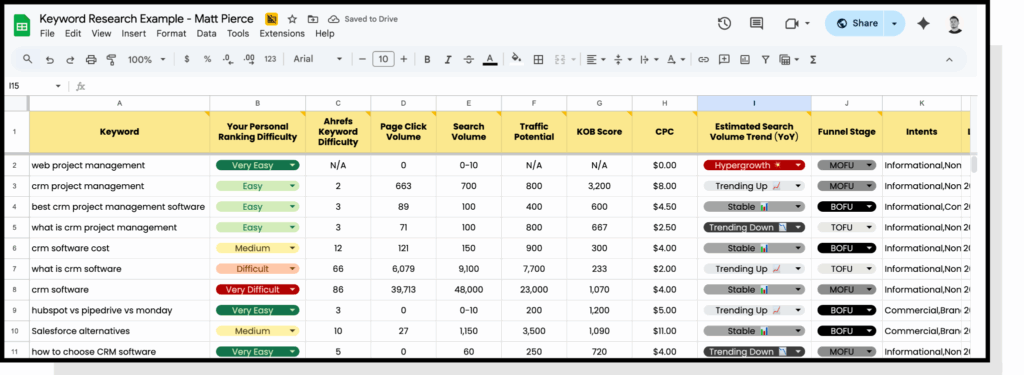
Once you have a comprehensive list and you’ve exhaused all ideas, export your list into a spreadsheet. Then, filter out unnecessary data, and keep only the data that’s most important to you. For example, I keep things like:
- Ahrefs Keyword Difficulty
- Page Click Volume
- Search Volume
- Traffic Potential
- KOB Score
- CPC
- Search Volume Trend
- Funnel Stage Intents
- Last Update
The metrics you keep should be determined by your goals and KPIs. Here’s a keyword spreadsheet that I created as an example, to show you what mine look like.
Creating a Topic Cluster
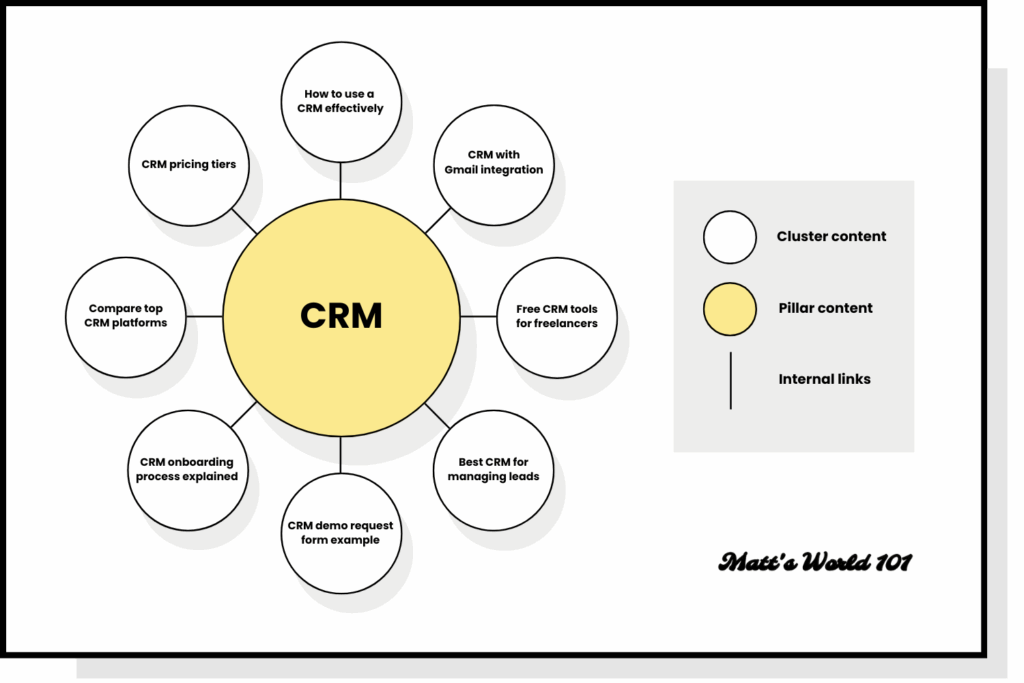
A topic cluster is an SEO strategy that organizes your content around a main “pillar” page with multiple related subtopics. This structure improves how well search engines understand your site and boosts your topical relevance.
Let’s say you’re a CRM SaaS company. You want to rank for the core term “CRM”, which is very competitive. The idea would then be to create a topic cluster around the term “CRM”.
Meaning you’d have one main pillar page targeting the “CRM” keyword, and dozens of related pages surrounding it. The more competitive your core keyword is, the more content and links you’ll likely need to rank for it.
It’s ideal to create your pillar page as something broad, like “The Ultimate Guide to CRM”, or “What Is CRM? A Comprehensive Guide”. This way, it’s easy for your related pages to internally link back to.
Like any on-page SEO strategy, internal linking is absolutely vital to your topic clusters. It’s ideal to link every single supporting page to the core page.
Helpful internal links benefit readers and search engines. They help search engines crawl and analyze your sitemap, and they also help readers when properly implemented.
On-Page SEO for SaaS
On-page SEO is the foundation of SEO and content. Without great copywriting and on-page optimization, your
Optimize Title Tags and Headlines
Your title tag is the first thing prospects see in search results before they decide to click. For B2B SaaS companies, this is crucial because you’re competing against established players with bigger marketing budgets and stronger site authority.
Keep your primary keyword near the front of both your H1 and title tag. Your title tag needs to be enticing while staying under 600 pixels to avoid getting cut off in the search results.
Make your titles stand out by:
- Adding year dates for freshness (“CRM Best Practices 2025”)
- Including specific numbers (“9 Ways to Reduce Churn by 40%”)
- Highlighting speed benefits (“Set Up Automation in Under 5 Minutes”)
- Using your brand name if you’re well-known in your industry
Your focus should be on attracting qualified prospects who are actively researching topics related to your industry. A title like “Why 500+ SaaS Companies Choose [Your Tool] Over Salesforce” immediately builds credibility and positions you against a major competitor.
Your H1 should match your title tag when possible, but also prioritize user experience. If someone lands on your page, they should immediately understand what value you’re providing and how it relates to their search query.
Structure URLs for Users & Search Engines
Short but descriptive URLs build tons of trust with prospects who are evaluating your content. For SaaS companies, this matters even more because longer sales cycles mean prospects can bookmark your content, share it with team members, and return multiple times before making decisions.
Keep URLs short while including your target keyword. Use your site architecture to provide context—something like “yoursite.com/project-management/integrations” immediately tells users where they are in your content hierarchy.
URL best practices for SaaS:
- Avoid keyword stuffing (don’t do things like “project-management-software-project-management“)
- Remove stop words like “and,” “the,” “for,” unless they’re essential
- Use hyphens instead of underscores to separate the words in your URL
- Keep the structure logical: yourdomain.com/category/specific-topic
Here’s an example: If you’re targeting “CRM automation workflows,” use “yoursite.com/crm/automation-workflows” instead of “yoursite.com/customer-relationship-management/automation-workflows-for-sales-teams.”
This way, it helps search engines understand your site structure, and users navigate much easier.
Copywriting That Converts SaaS Prospects
B2B SaaS buyers typically need lots of information before making purchasing decisions. Your content needs to match their search intent while naturally positioning your solution as the best choice.
Start strong with your introduction. Include your primary keyword in the first paragraph and immediately address the prospect’s pain point.
Don’t bury the value 1,000 words in. B2B buyers are usually busy and need to know they’re in the right place quickly.
Optimize readability and engagement by:
- Breaking content into skimmable sections with benefit-focused subheadings
- Using bullet points and numbered lists (like this one)
- Keeping paragraphs to 3-5 lines maximum
- Writing at an 8th-grade reading level so the average reader can understand you better
- Including your target keyword naturally throughout the content, don’t overdo it
Use subheadings the right way. Instead of generic titles like “Features,” try “How [Your Tool] Reduces Manual Data Entry by 75%.” This way, you’re targeting related keywords while showing the specific benefits readers get.
Answer the questions your prospects are actually asking. Check Google’s “People Also Ask” section for your target keywords and address those questions within your content. This keeps readers on your page instead of bouncing back to search for more information.
Optimize On-Page Technical Elements
Page speed directly affects your rankings and conversion rates. Most readers will leave slow-loading pages, especially if they’re comparing you with competitor content.
Technical priorities for SaaS websites:
- Compress images to reduce file sizes without losing quality (I love using Kraken.io for this)
- Aim for page loads under 3 seconds (use tools like Pingdom to test)
- Use descriptive alt text for images (helps with accessibility and SEO)
- Optimize for Core Web Vitals (LCP, FID, CLS)
- Set font sizes between 17-22px for better readability
Don’t neglect images. Your product screenshots and feature demos are often the most compelling part of your content. But large file sizes can kill your page speed. Use JPG for photographs and PNG for graphics with fewer colors.
Alt text serves two purposes: it helps visually impaired people understand your content, and gives search engines context about your images.
Instead of “dashboard-screenshot.png,” write “CRM dashboard showing lead conversion rates and pipeline metrics.” Smaller SEO benefit, but it certainly helps.
Add Internal and External Links
Internal linking is one of the most underrated ranking factors for SaaS companies. It helps prospects discover related content while building topical authority around your core product categories.
Here are some SaaS internal linking best practices:
- Link to relevant product pages from educational content
- Connect related blog posts to keep prospects engaged
- Internal links should always be helpful, not irrelevant
- Use descriptive anchor text that provides context
- Link from high-authority pages to newer content
- Aim for around 2-3 internal links per 1,000 words
For external links, link to trustworthy sources that support your points. This builds trust with prospects who are researching solutions and validates your expertise.
External linking best practices:
- Link to industry studies/research that support you
- Reference tools and platforms your audience already uses
- Open links in new tabs to keep prospects on your site
- Aim for 2-3 external links per post to authoritative sources
Create content that educates readers and naturally guides them toward your product. Every internal link should serve the buyer journey, whether that’s providing more product details, showing social proof through case studies, or overcoming objections through FAQs.
Content Updates for SaaS
The average page-one result gets updated about every 700 days. That’s two years, not the “evergreen forever” approach many SaaS companies still use.
While you’re focused on creating new blog posts, your existing comparison pages and feature content are quietly losing rankings to competitors who actually refresh their content.
If you think that “[Your Tool] vs HubSpot” post from 2021 is still pulling its weight, you’re probably wrong.
High-Converting Content Needs Attention
Your refresh strategy should match your business priorities, not some content calendar. Here’s what the data shows for SaaS companies:
Content requiring frequent updates:
- “Best software” comparison posts (update every 143 days)
- High-intent competitor comparison pages
- Pricing and feature comparison content
- Product alternative roundups
Content you can refresh less often:
- Educational “what is” content (every 2+ years)
- Industry trend pieces and thought leadership
- Basic how-to guides and tutorials
This means your most valuable pages will usually need the most work. It often makes the most sense to update what was once performing well and has recently dropped in performance.
Update Old Content Before Adding New
Here’s advice that might sound crazy coming from a content strategist: stop creating new content and optimize what you already have.
Why refreshing is sometimes better than creating new content:
- Existing pages already have domain authority and backlinks
- You’re building on proven SEO equity instead of starting from zero
- Refreshing costs less while often delivering better ROI
- Pages already convert visitors, you’re just optimizing what works
Plus, your competitors are probably doing this while you’re chasing new keyword opportunities.
SaaS Content Updates That Convert
Forget “fake” updates, like changing the publish date or only changing a few random words.
Those worked way back when, but Google has since caught on to the manipulation from bad SEOs out there. Revenue-focused updates require more effort:
1. Audit pages that drive qualified leads using Google Analytics and your CRM data. Focus on content that actually converts visitors into trial users.
2. Update competitive information: Feature comparisons and capabilities, current pricing and plan structures, new integrations and product releases, customer count and company milestones
3. Refresh social proof and examples: Recent customer success stories, updated ROI data and case studies, current user testimonials and reviews
4. Optimize for current search intent because how prospects research SaaS solutions changes sometimes.
Your refresh priorities should be for pages that drive pipeline growth. Not just your organic impressions or traffic.
Landing Pages: Fundamentals for SaaS
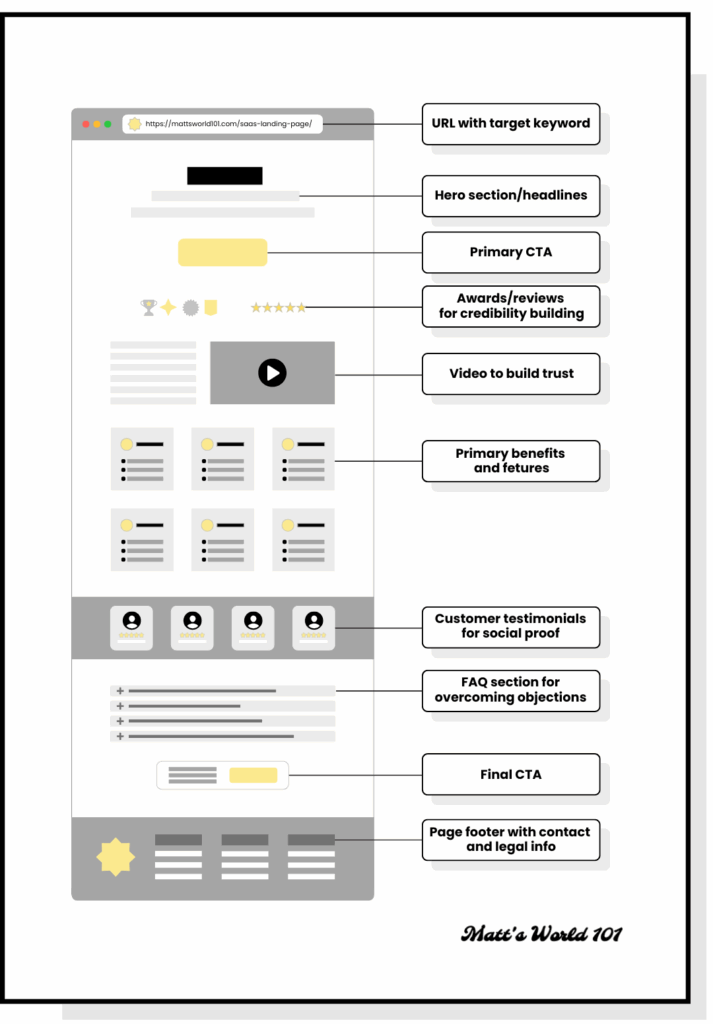
Here’s the exact landing page blueprint that consistently drives conversions for SaaS companies:
Hero Section That Converts
Your hero section needs to grab attention immediately and communicate value within seconds. Here’s what to include:
- Company logo: Make your branding instantly recognizable
- Benefit-focused headline: Skip feature lists and focus on the compelling outcome your product delivers
- Supporting subheadline: Add context that reinforces your main value proposition
- Standout primary CTA: Use a button that contrasts with your design and drives users toward conversion
- Social proof elements: Display user count, customer logos, or ratings to show others trust your product
- Product visualization: Include screenshots, videos, or GIFs that demonstrate your software in action
Benefit-Driven Product Section
This section should focus on outcomes, not features:
- Core benefit breakdown – Highlight your 3-4 main benefits with brief explanations of how you deliver them
- Visual reinforcement – Use product screenshots or mockups that support each benefit claim
Trust-Building Social Proof
Double down on credibility with additional proof points:
- Customer testimonials – Include specific quotes that address common objections or highlight key benefits
- Brand credibility signals – Display logos from recognizable companies or notable individual users
Solid FAQ Section
Turn objections into conversion opportunities:
- Address common concerns – Answer the questions that typically prevent purchases
- SEO-optimized questions – Use Google autosuggest and keyword tools to find search-friendly questions that target your main keywords
Conversion-Focused Final CTA
- Create urgency and push users toward immediate action with a final call-to-action.
Internal Linking Strategy
Keep users engaged and improve SEO:
- Feature page links – Connect to related product features to extend user sessions
- Optimized anchor text – Link to this landing page from other site pages using keyword-rich anchor text
Mobile-First Optimization
Have flawless mobile UX:
- Fast loading speeds – Optimize for quick mobile load times
- Touch-friendly navigation – Make buttons and links easy to tap
- Mobile-optimized CTAs – Ensure conversion elements work perfectly on smaller screens
Add Footer Elements
Complete the page with:
- Contact details – Include email, phone, and support links
- Legal compliance – Add Privacy Policy and Terms of Service links
Scale Across All Features
Repeat this exact process for every major feature your SaaS offers.
We built 8 feature-focused landing pages using this framework for a B2B SaaS client. The results speak for themselves:
- Ranking for direct product searches
- 20,000+ monthly visitors from high-intent organic traffic
The strategy works. Each landing page becomes a conversion asset that compounds over time through organic search visibility.
SaaS Link-Building: Relationships 1st
At its core, link-building is about building genuine relationships with people who can potentially link to your website.
Most companies get this backwards. They shift all their attention to link metrics, DR scores, and outreach volume instead of focusing on the actual human beings behind the websites.
This transactional approach leads to spammy pitches, ignored emails, and links that provide zero long-term value.
Link-Building for SaaS is Different
Your prospects research for months before making purchase decisions. They read multiple articles, compare dozens of tools, and seek recommendations from trusted sources. The websites linking to you become part of that trust-building process.
When a respected industry publication links to your comparison guide, they’re essentially vouching for your credibility to their audience.
When a thought leader references your research in their newsletter, they’re introducing your brand to potential customers who already trust their opinion.
This is why relationship-focused link building delivers better results than purely tactical approaches.
The strategies below focus on providing genuine value first. Instead of asking “How can I get a link from this site?” ask “How can I help this website owner serve their audience better?” This mindset shift changes everything about how you approach outreach and content creation.
1. Guest Blogging
Most people approach guest blogging completely wrong. They mass-pitch every blog in their industry with generic templates, focusing on quantity over quality. This approach is dead.
The new version of guest blogging is all about intention and education. Instead of chasing every opportunity, target mid-to-top-tier publications that regularly share valuable content without explicitly advertising guest post opportunities.
What works: Look for sites where your target audience actually spends time. If you’re selling project management software, don’t just target “project management blogs.” Target publications where busy executives and team leaders go for business advice.
Your content strategy should be educational first, promotional never. Write genuinely helpful content that solves real problems for their audience. Include one thoughtful link back to a relevant resource on your site, but make sure it adds value to the piece.
Pro tip: Don’t duplicate your existing content. Google penalizes duplicate content, so create unique angles tailored to each publication’s specific audience. The effort shows, and editors notice.
2. Broken Link Building Method
This strategy is perfect for SaaS companies because it’s relationship-focused and provides genuine value to website owners. Plus, it has one of the highest success rates of any outreach strategy when done correctly.
Start by creating comprehensive, linkable assets. Think “Ultimate Guide to Customer Data Security” or “Complete SaaS Integration Checklist.” These need to be genuinely useful resources that people would bookmark.
Then find opportunities using search modifiers:
- “inurl:resources” + your topic
- “inurl:links” + your industry term
- “useful links” + your subject
When you find broken links on relevant resource pages, reach out to the site owner. Let them know about the broken link and suggest your content as a replacement.
The secret sauce: Your outreach should be helpful first, self-promotional second. Lead with the value you’re providing by identifying their broken link. Most website owners genuinely appreciate this heads-up and are happy to link to quality alternatives.
Email template that works: Keep it short and specific. Mention the exact broken link, explain why it’s relevant to their audience, and offer your resource as a replacement. No long pitches or multiple follow-ups needed.
3. Passive Link Building
This is where the real magic happens. Instead of constantly chasing links, create content that naturally attracts backlinks over time. We call this “passive link building,” and it’s the most scalable strategy for SaaS companies.
Look for topics in your industry that consistently earn backlinks. Use tools like Ahrefs to identify content pieces that have both high traffic and growing link profiles. The ideal content shows gradual, steady link growth rather than one-time spikes.
Examples that work for SaaS companies:
- Original industry benchmarking studies
- Annual state-of-the-industry reports
- Comprehensive tool comparison guides
- Technical how-to resources with unique perspectives
The compound effect is remarkable. Some content pieces earn 900% more backlinks over 18 months compared to their first month of publication. This happens because people naturally reference and cite valuable resources when creating their own content.
Focus on search-driven topics rather than purely link-driven content. Content that ranks well in search engines naturally attracts more organic mentions from other creators who discover it through search.
Once you create this type of content, it works for you 24/7 without any additional outreach. It’s the closest thing to “set it and forget it” link building that actually works.
These three strategies require more upfront effort than spray-and-pray approaches, but they deliver links that actually impact your rankings and drive real business results.
Technical SEO for SaaS
Technical SEO is important. But in my opinion, it’s one of the less important aspects of SEO, at least when it comes to most SaaS websites.
Most SaaS sites only have a few hundred pages. Technical SEO most important on larger websites that have thousands of pages and a complex site structure.
For example, ecommerce sites with 30,000+ product pages, news websites publishing dozens of articles daily, or marketplaces with complex filtering and pagination systems.
These sites often will have crawl budget issues, duplicate content nightmares, and technical complexities that can completely tank their organic visibility if not handled correctly.
But most SaaS sites have these problems far less often than industries like ecommerce. Regardless, technical SEO is still a necessity for your site.
Technical Issues Hiding On Your Site
Your biggest technical problems are probably invisible to you but crystal clear to Google’s crawlers.
The most common SaaS technical issues:
- Duplicate content across feature pages because you copied descriptions from one plan to another
- Missing canonical tags on similar pages like “Enterprise pricing” and “Business pricing”
- Broken internal links pointing to old product pages or removed features
- Generic alt text on product screenshots instead of descriptive alternatives
Use tools like Screaming Frog (free for up to 500 URLs) or Google Search Console to identify these issues. Don’t try to fix everything at once, make incremental improvements.
Prioritize pages that are high performing and are already driving qualified leads.
Page Speed
B2B buyers typically compare 3-5 products before making a purchasing decision. If your pricing page loads in 6 seconds while your competitor’s loads in 2 seconds, guess who’s getting the demo request. Not you.
Google’s own research shows 53% of mobile users bounce from pages that take longer than 3 seconds to load.
For SaaS companies where prospects research solutions during commutes or between meetings, slow-loading pages matter a lot.
Focus on optimizing these conversion-driven pages first:
- Pricing and plan comparison pages (where purchase decisions happen)
- Trial signup forms, demo request forms, contact forms (your actual conversion points)
- High-traffic comparison content targeting competitor keywords (very BoFu content)
Meta Elements & Schema
In my experience, most SaaS meta descriptions sound generic, like they were written by AI:
“Seamless project management software for growing teams.”
Soulless, boring, and indistinguishable from every competitor. Your meta description is a 160-character sales pitch. Use it like one. Avoid spending too much time on them, though, since Google auto-rewrites them 50-70% of the time.
Instead of something like “CRM software for sales teams,” try “The CRM that helped TechCorp increase close rates by 40% in 90 days.”
Highly specific results and social proof improve trust and click-through rates, which signals to Google that your content deserves higher rankings. It’s also what readers prefer to see.
Schema markup lets you show pricing, ratings, and other features directly in search results while competitors display basic text snippets. It’s the difference between looking like a reputable page and looking like any other WordPress blog.
Internal Linking Strategy
Your internal linking should guide prospects toward conversion, not just satisfy SEO best practices. Link from educational content to relevant product pages, connect feature comparisons to pricing information, and make case studies discoverable from your problem-focused content.
Internal linking priorities:
- Educational blog posts to relevant product pages
- Feature pages to pricing and trial signup forms
- Case studies from industry-specific content
- Comparison posts to your pricing page
Tools & Implementation Strategy
Google Search Console should be your starting point. It’s a first-party tool, it’s free, and it shows exactly what Google thinks about your site’s technical health. Use it to find crawl errors, monitor Core Web Vitals, and track which pages are losing visibility.
For more comprehensive audits, Screaming Frog crawls up to 500 URLs for free and shows the technical issues that are killing your rankings.
But the biggest difference between technically advanced SaaS companies and everyone else is that they fix technical issues based on business impact. If an issue doesn’t really affect your main goals, why prioritize it?
Focus on problems affecting your highest-converting pages first, then expand to supporting content.
Technical SEO might not be glamorous, but it’s often the fastest path to improving SEO without creating new content.
How to Track & Measure Your SEO
Track the things that matter most first, but don’t forget about the smaller things.
- Start with revenue-focused metrics. While it’s tempting to celebrate traffic growth, revenue attribution should be your main focus. SaaS businesses have longer sales cycles, so someone might use your free trial for months before upgrading to a paid plan. This can make direct attribution difficult, but not impossible.
- Focus on conversion metrics that predict revenue. Track organic trial signups, product qualified leads (PQLs), and marketing qualified leads (MQLs) depending on your business model. These conversions are directly associated with your SEO efforts, and they’re some of the leading indicators of future revenue growth.
- Track keyword rankings for early success signals. Rankings provide early feedback on your SEO strategy effectiveness. Moving from position 100 to position 12 won’t generate conversions yet, but it shows that you’re heading in the right direction. Pay attention to search intent behind your target keywords, since informational queries convert differently than commercial queries.
- Separate branded from non-branded search traffic. Non-branded searches indicate people are discovering you organically, which demonstrates growing brand awareness and successful content strategy. This traffic typically has higher commercial potential than branded searches from existing customers, who already know you.
- Analyze organic traffic by content type. Understanding which content drives the most qualified visitors helps you allocate resources effectively. You might discover you’re creating too much top-funnel educational content when bottom-funnel comparison pages drive way more conversions.
- Calculate ROI from organic traffic. Track monthly recurring revenue (MRR) from organic sources, customer lifetime value of organic users, and how SEO impacts your customer acquisition costs. These metrics prove SEO’s financial impact on your business.
- Don’t ignore technical indicators. Monitor bounce rates/engagement rates to identify content-keyword mismatches, track crawl errors before they become major issues, and analyze organic click-through rates to understand user intent and content performance.
- Use the right tools for measurement. Google Analytics and Google Search Console give you accurate first party data, while tools like Ahrefs help with competitive analysis and backlink tracking.
Remember, in most cases, 20% of your pages will drive 80% of your SEO performance. Focus most of your effort on optimizing these high-impact pages instead of trying to track everything.
Now you have a complete organic growth guide for your SaaS. Feel free to get in touch with me if you need SEO help. Or, subscribe to my newsletter for tips on marketing, AI, and SEO.